
Summing Mixers
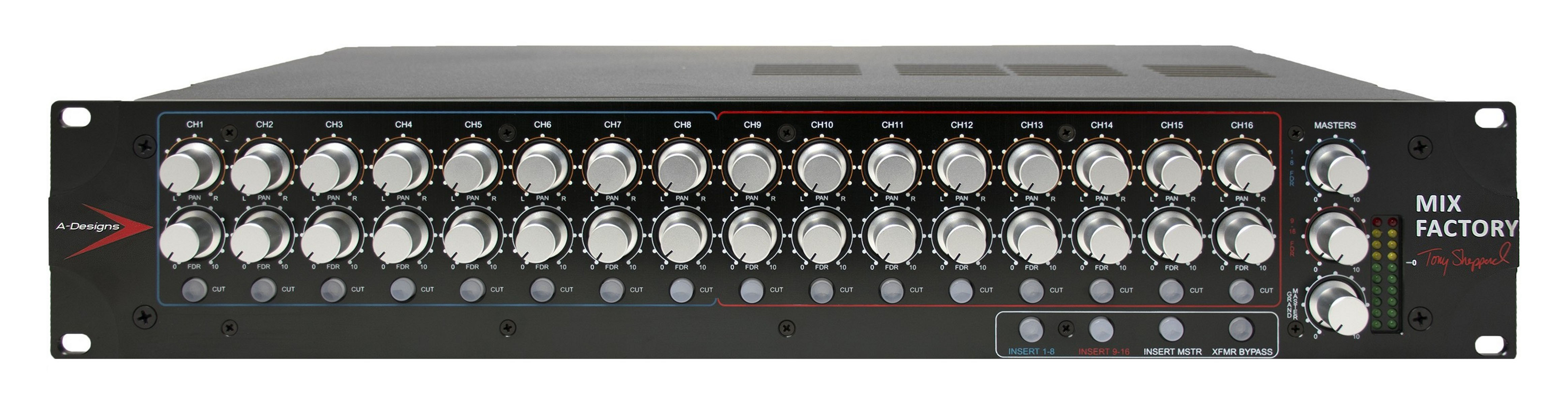
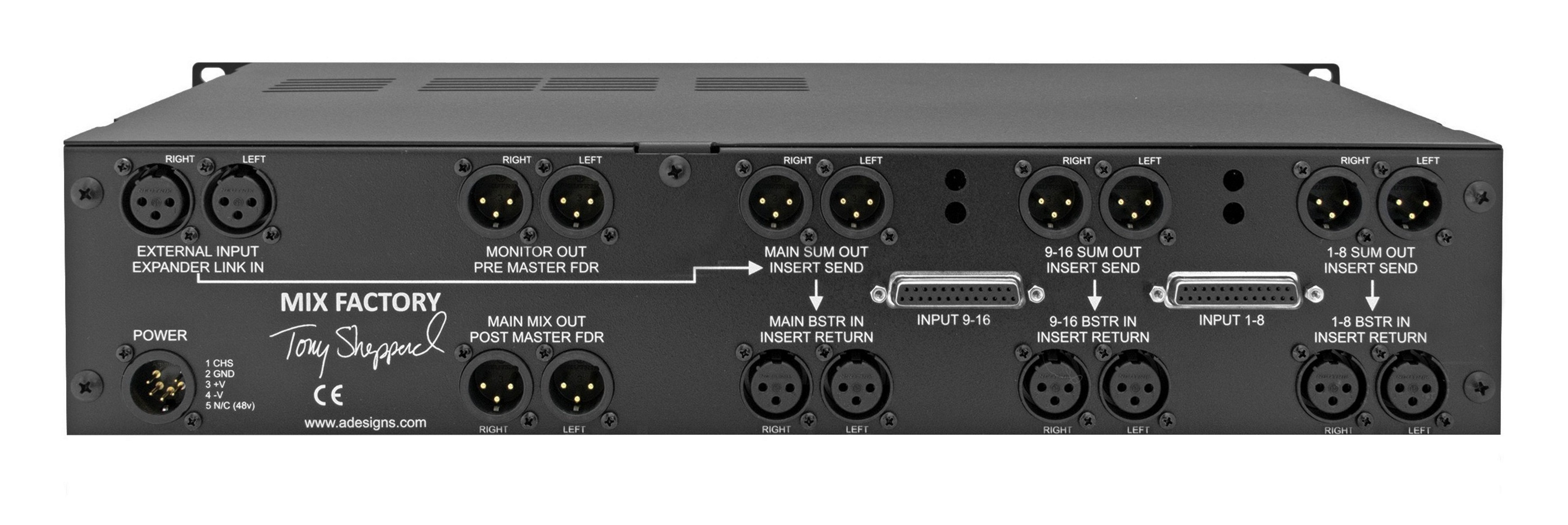
A-Designs’ Mix Factory Takes Summing to a New Level A-Designs Audio, Inc. is proud to announce the worldwide debut of its Mix Factory, a totally new concept and approach to “out-of-the-box” summing for musicians and engineers looking to get more from their current sound and workflow. “Our new Mix Factory isn’t just any old summing unit,” says A-Designs Audio’s Peter Montessi. “It delivers analog warmth with the depth and imaging needed to make your mixes truly stand out from the crowd.” Based on a concept developed by producer/engineer/mixer Tony Shepperd and brought to life by celebrated designer Paul Wolff, A-Designs’ new Mix Factory accommodates up to 16 audio channels, which come into the device on two D-sub inputs and sum to stereo XLR outputs. All 16 channels have a continuous FDR (gain) knob, pan pot with center detent, and cut (mute) switch that acts as a signal indicator with an audio sensitive LED, which glows when signal is passing into the channel and intensifies when the signal is stronger. That same cut button illuminates red when used as a mute, and green when signal is passing through the channel. There are two eight-channel groups on the Mix Factory: 1-8 and 9-16. Each group has an insert for a compressor or EQ, and there is also a master insert for all 16 channels, along with three mute buttons for each Insert. The Mix Factory has a pushbutton option to go from clean—the standard setup bypassing the transformers—to tonal using the custom-made output transformers manufactured by Cinemag. The difference between using the transformers and not is night and day, giving users an option for analog tone and/or color. A-Designs Mix Factory / Add One In situations where more than 16 channels are necessary, the Mix Factory is linkable, providing 64 or more channels… it’s like having a console in a rack! “Like many other present day engineers, I used to think that everything could be done ‘in the box’,” recalls Shepperd. “However, I finally came to realize that analog and digital could, in fact, co-exist very well together, and the hybrid of the two was the special combination that took my mixes to a whole new level. It’s what ultimately prompted many other recording engineers to call me for tips and practically demand to know how I made my recordings sound so great. After several years of R&D on this product, I can say that nothing will make a mix pop quite like A-Designs’ new Mix Factory.” A beefy, external, switchable power supply allows the unit to be used for both 120-volt domestic (US) studio environments as well as 230-volt export markets. Including the PSU, the 2U device weighs 17 pounds. Features Solid State Design Custom Milled Aluminum Knobs Custom Output Transformers 2RU Rack Space External Power Supply Balanced XLR Output 16 Gain Controls 2 Master Gain Controls 1 - 8 and 9 - 16 1 Grand Master Gain Control 16 Pan Controls Master Insert 1 - 8 Insert 9 - 16 Insert 16 Mute Switches Transformer In/Out Switch 22 Color Changing Switches LED Array Linking XLRs for more channels


The sound of Neve has been the audio recording benchmark for generations of leading engineers, musicians and producers. Wherever sound matters, from a full orchestral recording for a blockbuster film to a lone singer, from a rock drummer to an R’n’B vocal, Neve technology provides the warmth, punch and definition so sought after by modern and classic producers.The legendary sound of Neve now becomes available to DAW based producers. Sixteen input channels include level, pan, cut and cue controls. A +15dB gain range accommodates both -10dBv and +4dbm input levels. If sixteen inputs aren’t enough for your mix, multiple 8816 units can be cascaded together via the fixed level two track buss. The ultimate analogue mix buss utilises classic Neve transformer mixing topology. The mix outputs appear simultaneously as balanced +4dBm and unbalanced -10dBv. Mix Inserts are pre-fade for full control and can be switched between normal insert mode and mastering style sum and difference mode with stereo width control. An optional digital output converts the analogue mix to any standard PCM sample rate up to 192kHz or DSD, Output PPM meters are complemented by overload LEDs to indicate clipping at the ADC or analogue output. The monitor section selects between Mix Out, 2 Track Return, Channels 1 & 2 (DAW mix replay) and 'i-mon' front panel input mini-jack, handy for quick mix comparisons. The monitor level is independent of the mix level and the monitor outputs can be switched between Main and Alt speakers. A separate Cue Output can be fed from three sources and the inbuilt Talkback mic. Headphones can be used to listen to either Cue or Monitor source. A USB connector allows snapshots of the 8816 settings to be saved to a PC or Mac and recalled ready for remix. Instant Recall of settings stored on PC or Mac via USB16 input channels plus aux additional inputsCue, Level, Pan, Solo and Mute controlsClassic Neve analogue transformer mix bussMix Insert pointsVarious solo and solo in place functionsSum and difference insert with exclusive 'Stereo Width Control'Dance mix style insert Mix functionSeparate Monitor and Cue levels >Main and Alt speaker outsIn built talkback mic and headphone OutputOptional digital output cardUnits can be cascaded for multiple output2 rack U high with special shielded power supply Für weitere Informationen, besuchen Sie bitte die Homepage zu diesem Produkt.
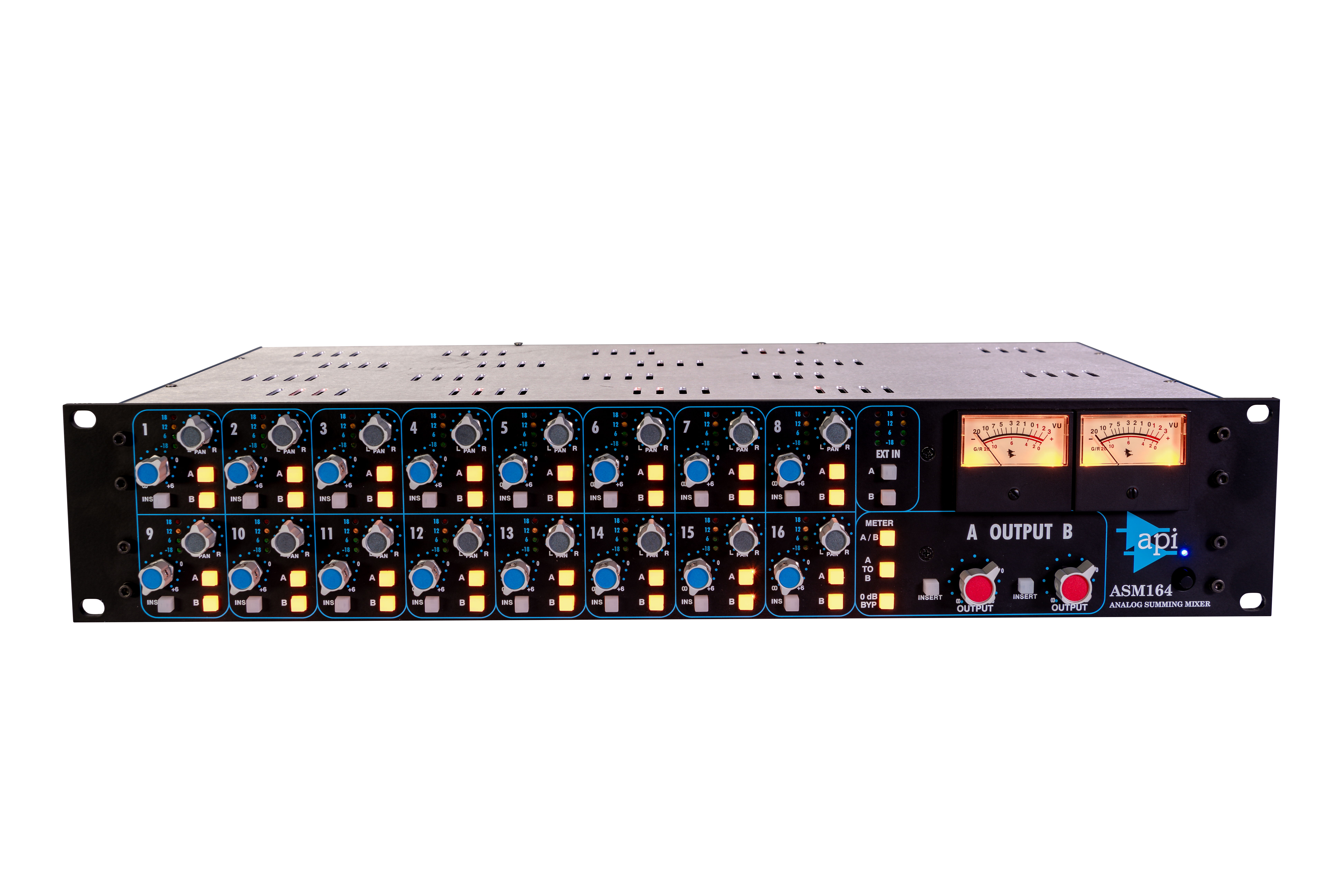
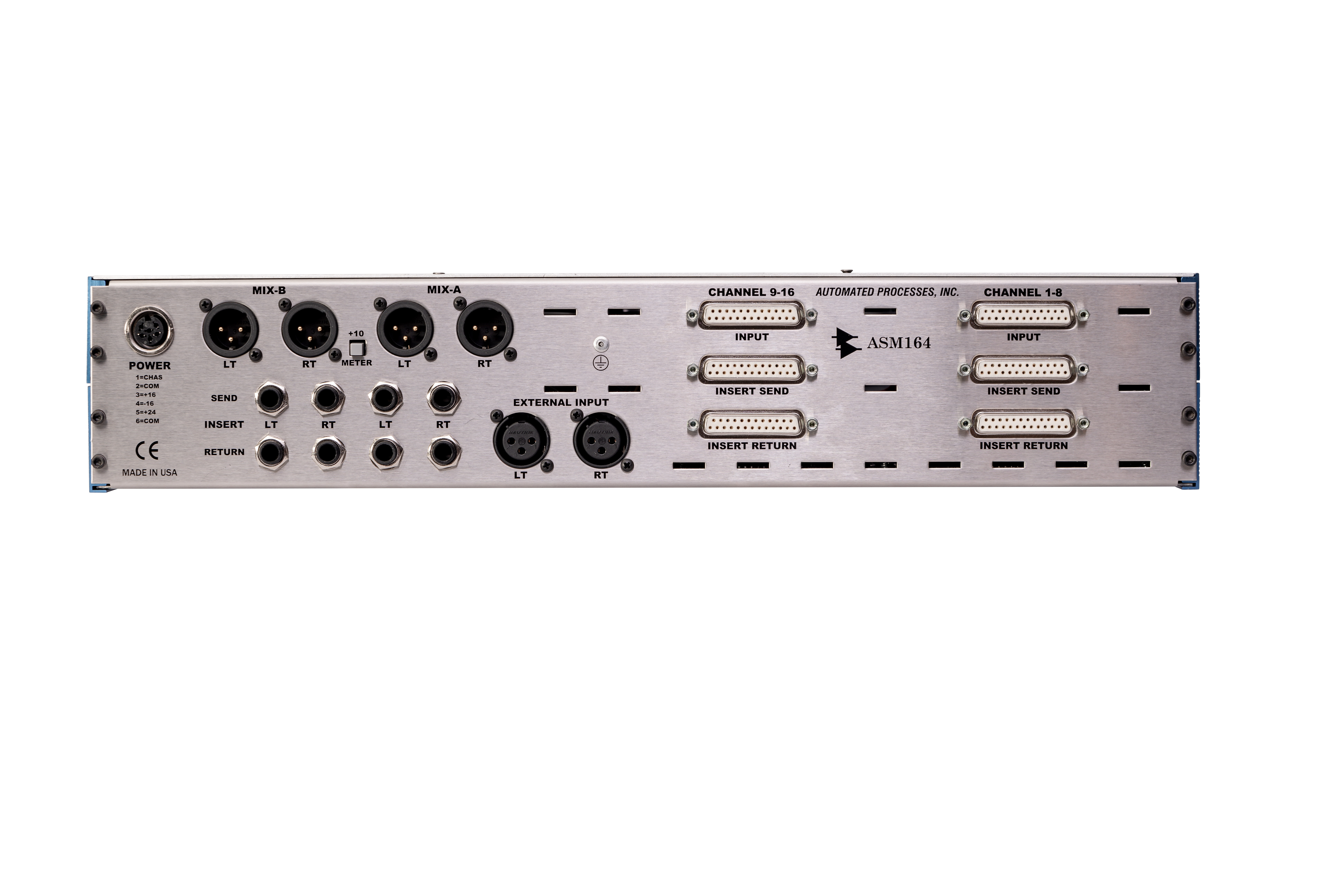
Building on API's rich heritage of extremely high-quality recording consoles, we introduce the ASM164, a 16-channel analog mixer that provides API summing performance in a convenient 19-inch rack format. With a design based on the summing section of THE BOX® Console, the ASM164 is designed for professional project studios, home studios, and production facilities of all kinds. The ASM164 is designed to provide the legendary API sound in an efficient, cost effective package.


32 x 2 Mix BusVANCOUVER Island in Canada’s British Columbia is a lush, fertile land of epic proportions. Teaming with wildlife and forests, life thrives in a temperate climate drenched with the precipitation of the North Pacific. The city of VANCOUVER on British Colombia’s mainland is a booming metropolis at the base of the Cascade Coastal Range. Known for its mind altering substances, VANCOUVER is a hot bed for creativity.

The 8 channel Gain module is also DC coupled and can control both audio and Control Voltage Signals. A Sum output allows any combination of inputs to be summed after the gain control. Three master groups allow any combination of channels to be controlled. · 8 Channels of Gain Control· Sum output, any combination of inputs· Individual select Switch for each channel· Channel Mute· Gain Control range -96 to +22dB· Resolution 0.25dB, 0.5dB or 1 dB· Three Master Groups with Mute and Gain
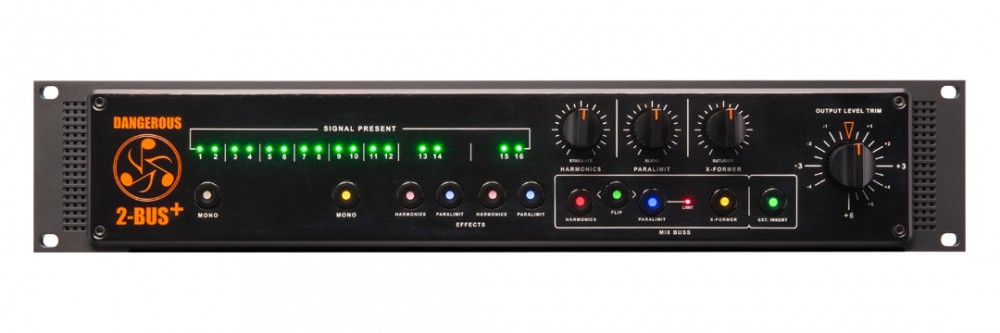
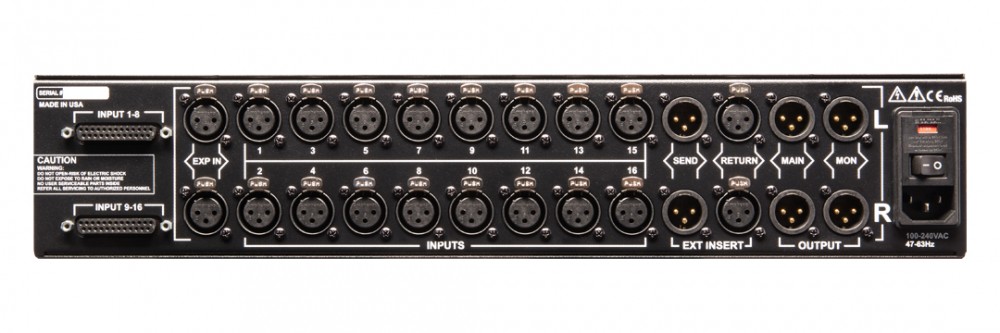
Dangerous 2-Bus + The new 2-BUS+ is a 2-space rack-unit, 16-channel analog-summing mixer, with both XLR and D-sub inputs. New innovative features include 3 separate custom audio processors to add tone and color to mixes. The ‘Harmonics’ processor is a tuned harmonic distortion generator executed in parallel-processing mode with a blend control, ‘Paralimit’ is a FET limiter on stun, also in parallel mode. Both of these processors can be applied across the stereo mix, or on a pair of stems. ‘X-Former’ inserts a pair of custom transformers on the stereo mix and has a control for core saturation. All three tone controls can be active at once, and the order of signal flow through distortion and limiting can be flipped. The new Dangerous 2-Bus+ (…pronounced “Two Bus Plus”) is expected to be available through dealers worldwide in Q3 2015
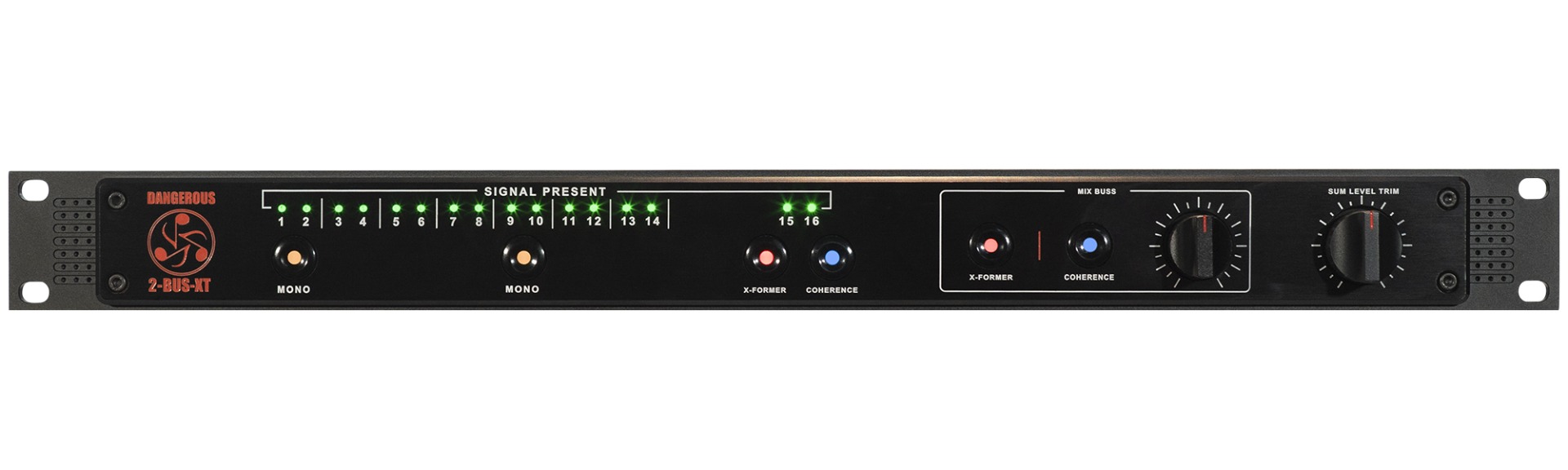
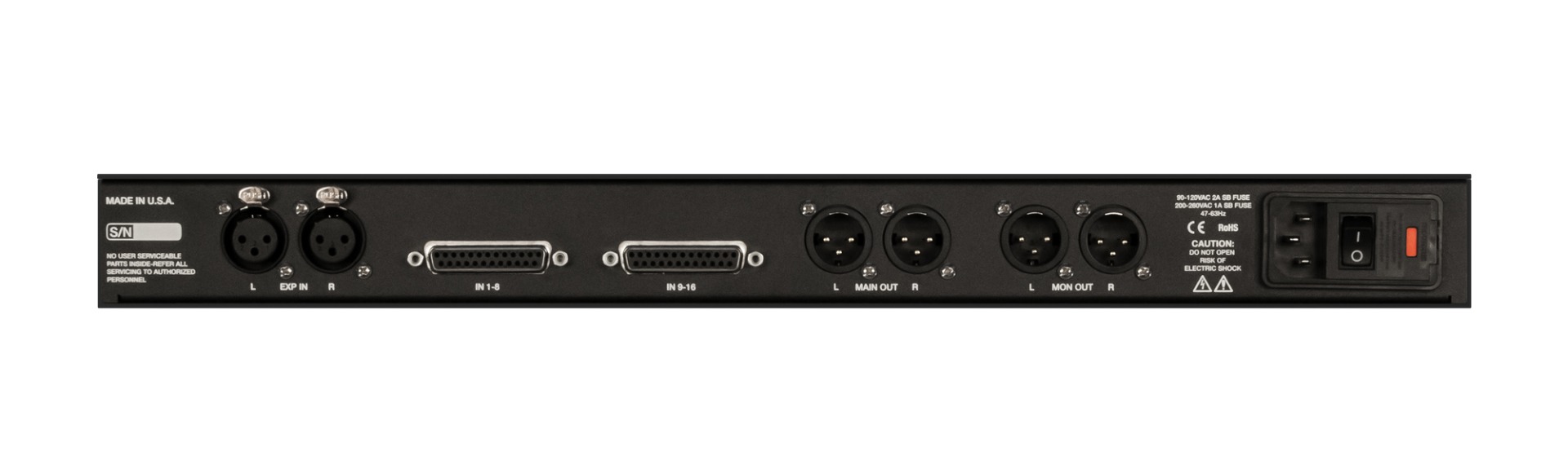
Features: 16 channels of active analog summing circuits designed by Chris Muth Crystal clear and wide stereo imaging and perfect center through a stunning -109dB crosstalk rejection Enormous headroom to meet today’s converters output level (+27 dBu max input level) Two unique colour circuits of Muth Magic: Transformer and Coherence, applicable to the sum, channels 15/16 or hard bypass Coherence features a blend control 2 of 8 stereo pairs switchable to dual mono (1/2 & 9/10) Expansion input for full expandability with additional summing units such as 2-BUS(+), 2-BUS LT, D-BOX(+) or simply another 2-Bus-XT 2 x DB-25 connectors for the inputs and 2 XLR stereo outputs for Main and Monitor Output trim potentiometer Signal present LEDs Only components of the high quality in the signal path Occupies only 1 RU of space Internal Power Supply Hand built in the USA Remember the 2-Bus LT? The device that preserved all the blessings of DAW-based work such as total recall while removing the unpleasant side effects of digital summing in a 1RU unit that is as simple as it is uncompromising yet inexpensive? The Dangerous Music 2-Bus-XT is the worthy heir of the 2-Bus LT which earned its merits in countless studios around the world. Still 8 pairs of stereo channels in 1RU but it comes with the looks and sonics of his big brother, the 2-Bus+. The extremely low cross talk and perfect stereo image provide a wide sound stage as well as a perfectly welded dead center lead vocals and knock down kicks. This results in better mixes in less time and with fewer plug-ins. On top of all that chief designer Chris Muth has added two switchable colour circuits: a transformer and a blend knob labelled Coherence for adding harmonics. The latter can be best described as phase coherent dimensional asymmetry. Both are applicable to either the sum, channels 15/16 or can be true hard wire bypassed. Both colour circuits differ from those in Dangerous Music’s 2-Bus+ and AD+ to give you even more choices when combining the 2-Bus-XT with one or both of those. Two mono selectors for channel 1-2 and 9-10 and a trim poti complete the 2-Bus-XT, two XLR stereo outputs for Main and Monitor plus an Expansion Input to add other summing devices as well as the two D-Sub25 Inputs for a total of 16 Channels on the back of the unit.


The MCM20.4 is a 20 channel mixer with the addition of 4 aux sends (2 mono and 1 stereo) and a class A 1073 output stage. 16 channels are laid out in 2 rows of 8 on the front panel, having fader, pan, insert and on/off controls. These are actively sub grouped into 2 stereo subs, again with insert points and dedicated stereo faders. The 4 additional inputs (hard panned left and right and at unity gain) can be accessed from the back of the unit. These can be used as FX Returns, cascading mixers or simply as additional stereo channels. The aux sends section can be used pre or post fader and features 2 mono sends (1 and 2) and alternatively, a third stereo aux can be used. Hard panning the stereo aux turns this into 2 mono auxes. Master faders for all sends are provided. The Master Bus has indeed its own insert point and dedicated Fader. All inputs and outputs, included inserts, are balanced. All connections are on DSUB 25s following the Tascam protocol, with the exception of the Master Bus related ones, which are on XLRs. Stereo output is duplicated for easy Mix / Monitor splitting. The combination of active and passive mixing topologies, together with the use of heavy gauge ground busses, gives an exceptional low noise and high headroom. Features 20 channel summing mixer 16 channels with volume, pan, mute, insert on/off and aux send level control 2 stereo intput channels with unity gain 1073 class A output stage 2 subgroups and 3 aux sends Stereo-Mix and Monitor output Insertpoints per channel, subgroup and master channel Low Noise and high headroom performance. Active subgroup and passive master bus summing
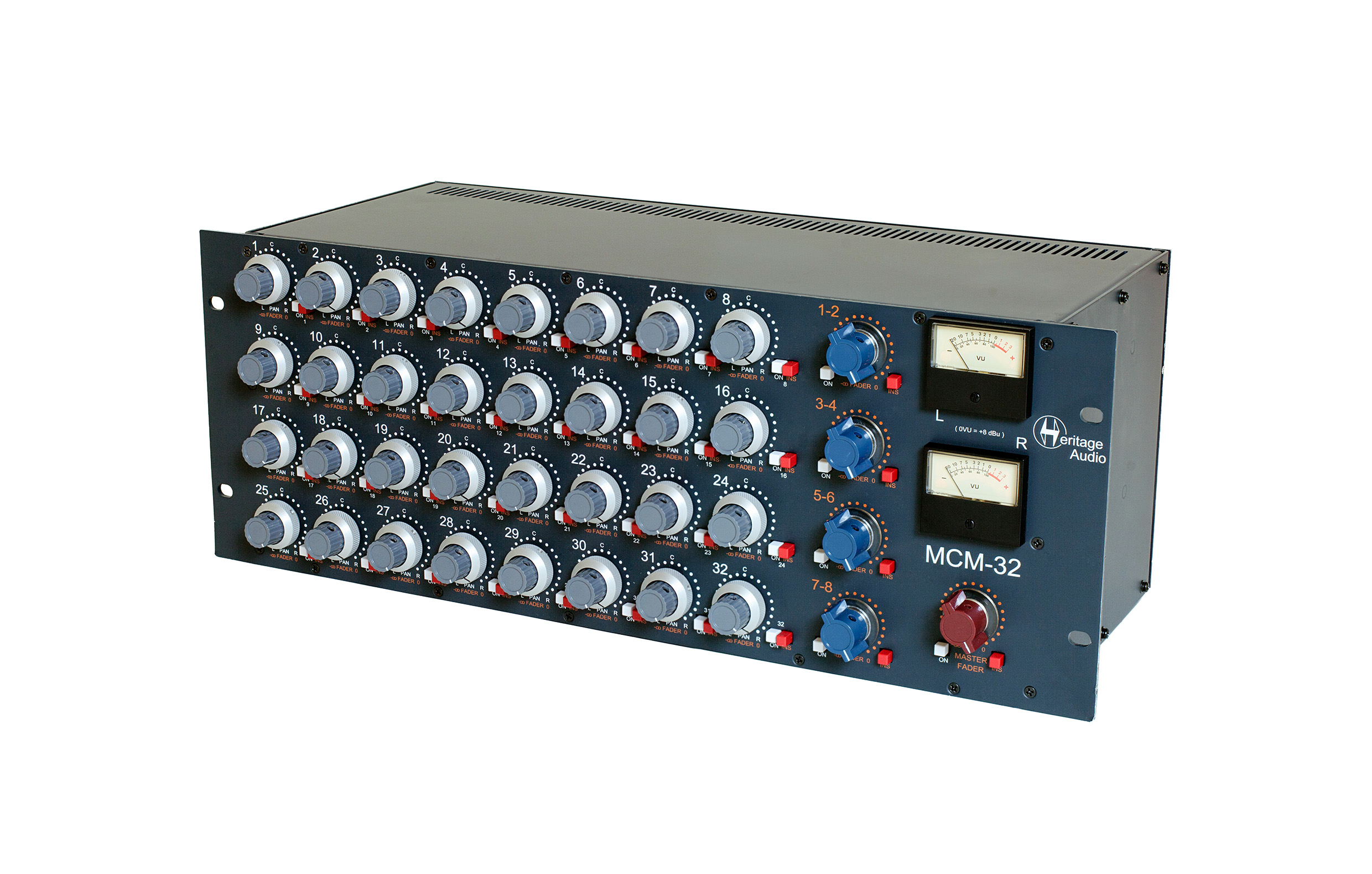
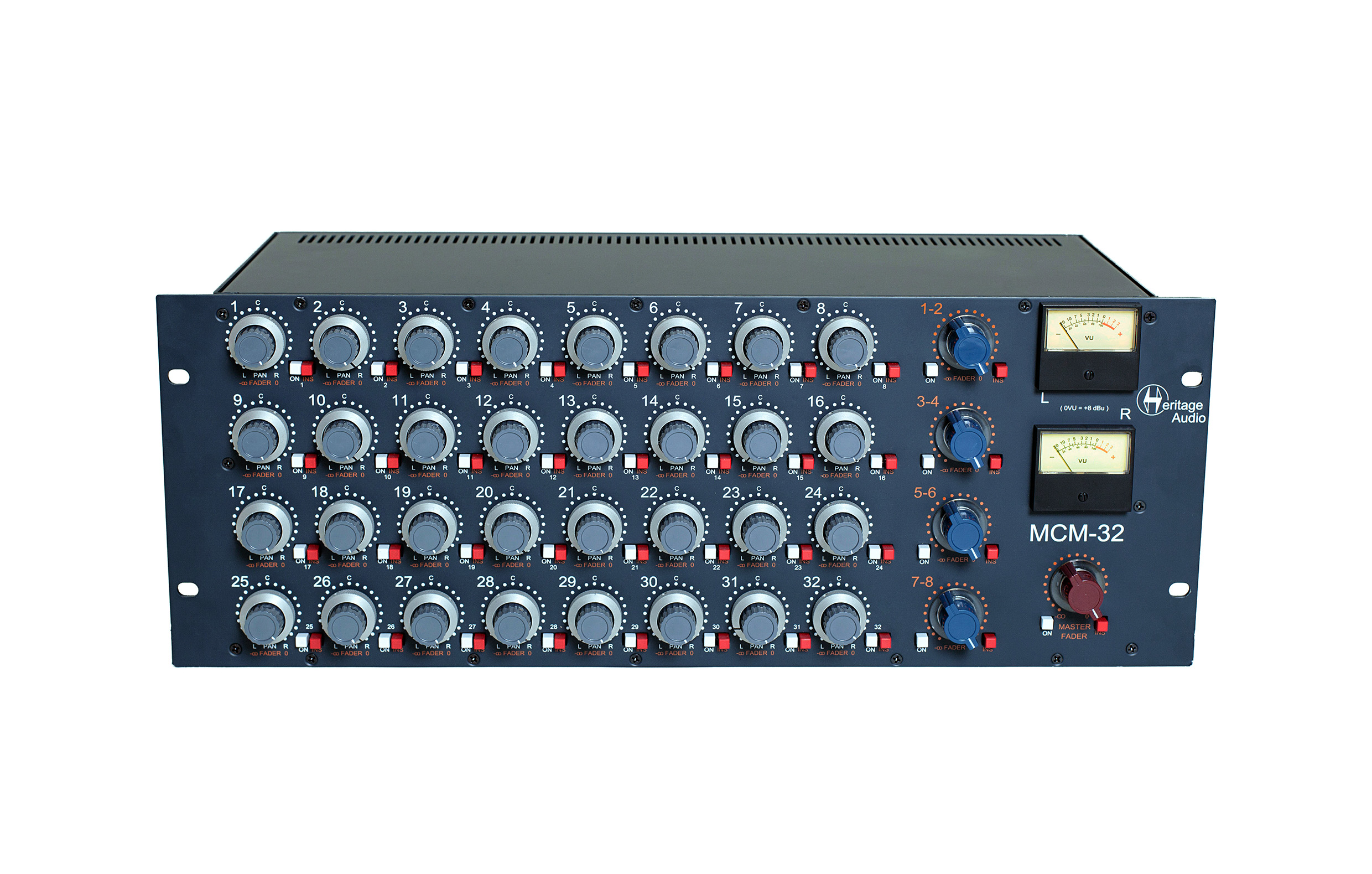
The MCM-32 is a 32 channel mixer with a class A 1073 output stage. Every channel features insert points, fader and pan controls, as well as On/Off switches. Its innovative subgrouping system actively sums each row of 8 channels into a stereo subgroup. Subgroups feature their own dedicated stereo faders and insert points. All 4 Stereo Subgroups are passively summed into the Stereo Master Bus, employing the same discrete, class A transformer based summing topology of the vintage 80 series consoles. The Master Bus has indeed its own insert point and dedicated Fader. All inputs and outputs, included inserts, are balanced. All connections are on DSUB 25s following the Tascam protocol, with the exception of the Master Bus related ones, which are on XLRs. Stereo output is duplicated for easy Mix / Monitor splitting. The combination of active and passive mixing topologies, together with the use of heavy gauge ground busses, gives an exceptional low noise and high headroom, not often associated with 32 channel mixers. Features 32 channel summing mixer Volume, pan, mute and insert on/off control per channel 1073 class A output stage 4 subgroups Stereo-Mix and Monitor output Insertpoints per channel, subgroup and master channel Low Noise and high headroom performance. Active subgroup and passive master bus summing


SATUR-8/24 is the 24 channel summing unit containing 8 channels with analog saturation. The design refers to the sound of old tube mixing consoles and tape recorders. The summing module is an original combination of active summing, run by operational amplifiers and passive voltage summing based on transformers. The mixed signal is amplified by a transistor preamplifier operating in pure class A, built of discrete elements, inspired by the early designs of transistor preamps from the 60's. Additionally the summing circuit is fitted with a “Magic” module, which magically nears, widens and thickens the whole mix, giving it a vivid, analog sound. SATUR-8/24 is both versatile and creative tool for processing of tracks, subgroups and the entire mix.
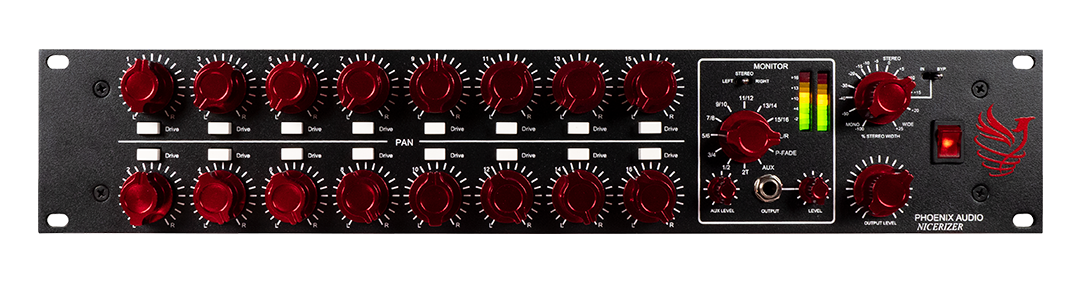
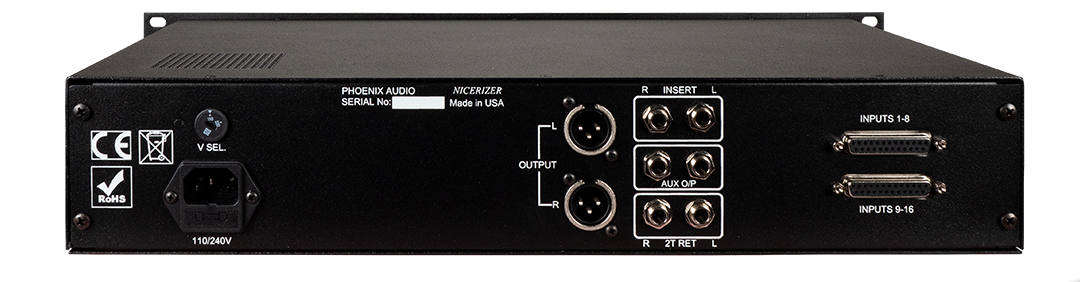
Phoenix Nicerizer AN EVOLUTION OF THE LEGENDARY TONE MACHINE Analog Summing In The Digital Age Recording software companies brag about their “mixer,” but discerning engineers won’t settle for in-the-box mixing when the dimension, punch, and articulation of analog summing can vastly improve their productions. Phoenix’s Nicerizer series summing mixers incorporate features and circuitry that have made it a legendary tone machine. A Summing Mixer (not Amplifier) The distinction between a stereo mixer and a summing amplifier is important when considering your hybrid analog/digital rig. In essence, a mixer incorporates a fuller range of features. The Nicerizer is decidedly a mixer, pulling crucial elements such as circuit overdrive and panning back into the analog realm where they truly outperform their digital emulations. Our dented pan-pots are unmatched for both precision stereo placement and ease of recall, and they are a key ingredient the huge, open sound of the Nicerizer. Driving a Versatile, Class-A Input Circuit with our 'Drive Technology'With the Nicerizer, Phoenix takes a modern approach to Class-A circuit design. Our unique transformerless input stage delivers the full frequency spectrum with unrivaled clarity and punch. Transformers slow things down, which can be great in some cases, but if you’re stuck with transformers, then you’re stuck with slower transients (slew-rates), limiting the range of tonalities. Our electronically balanced input stage can be driven modestly for ultra-clear hi-fi sound, or you can engage the drive switch on any of the 16 channel individually to drive the circuit for a fatter, more saturated sound that only Discrete Class-A buffer amps annd custom wound output transformers can deliver.Legendary Transformer-Balanced Output StageOnce mixed, the stereo signal hits a pair of our custom-wound DB694 output transformer, which we’ve coupled to Phoenix's proprietary, fully discrete DSOP-2 output amplifier. The DSOP-2 is the result of Phoenix's head-designer David Rees’ forward-thinking solutions for upgrading vintage Neve consoles. Improve on Neve? Indeed, the DSOP-2 represents the pinnacle of Class-A output circuits, offering a smooth transition from ultra-clean to beautifully saturated tones.Extra Features That Quickly Become Essentials Stereo Width Control—The Nicerizer’s width control uses elements of Mid/Side processing to offer your mixes a narrower or wider image simply by turning a knob. Mix engineers who haven’t used a width control often don’t realize what they’re missing: a level of spacial manipulation that can unlock hidden dimensions or tighten up a sprawling production. Balanced, Unbalanced: No Problem—The Nicerizer’s 16 individual inputs can accept both balanced and unbalanced signals without any of the gain loss typical on most mixer inputs. This is an increasingly useful feature as looping through guitar pedals and even recording midi-driven analog synths in real time while mixing are fast becoming standard practices. Stereo Bus Insert—Strap any balanced or unbalanced gear onto the main mix bus for added control. A common practice today while mixing is to strap a bus compressor, and often an eq, onto the stereo bus, yet mastering engineers will also love this feature when working with stems. Independently Controlled Aux Output—Just before hitting the output transformers, we have grabbed an output signal and assigned it to its own front-panel level control. Drive external monitoring amps, or simple bypass our output stage for a transfomerless sound to your final capture device. 2T Return—Another feature that makes the Nicerizer a true mixer is the 2-track input, allowing you to monitor an external output source through the onboard headphone amplifier. Monitor Select Switch—An industry first, this switch allows you to monitor single pairs of channels (1-2, 3-4, etc), as well as any of the other stereo ports on the Nicerizer. Infinitely useful for a multitude of workflows, this switch is the sleeping giant of the mixer, ready to unleash all kinds of creative uses, from doing individual stem work to comparing reference mixes to allowing direct comparison of many analog sources. Monitor Select Switch Toggle—Once you’ve chosen which input pair you’d like to monitor via the Monitor Select Switch, the Toggle lets you monitor either the Left or Right channels in mono (sent to both channels) on the headphone amp, or to monitor in stereo. Forensic analysis of your audio signals has never been easier. LED Meters—Following the Monitor Select Switch, our LED meter array will give you constant visual confirmation of your operating levels. Indispensable for managing gain as you finalize your productions.
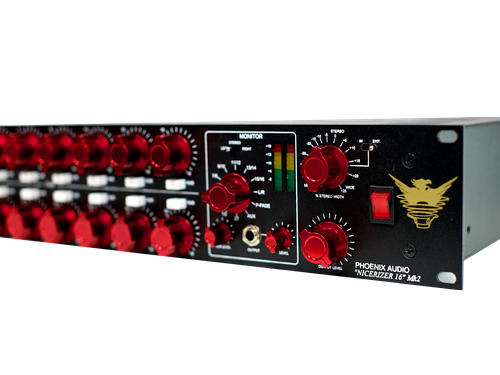
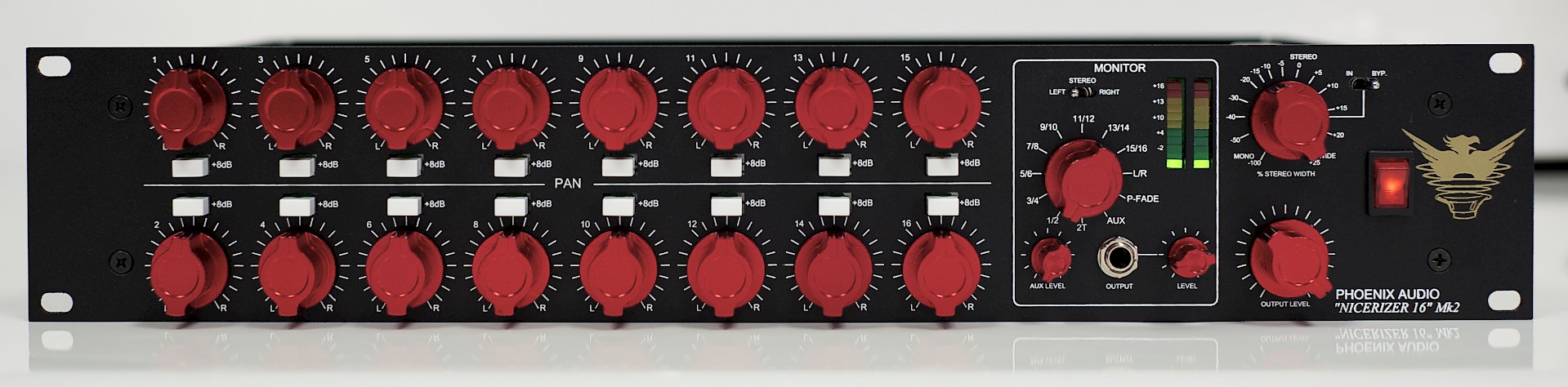
At a Glance The Nicerizer 16 is a 16 Channel DAW Summing Mixer 2U 19″ rack mountable Transformerless Balanced Class A Discrete Line Input Technology 16 Channels Stereo LED level monitoring Transformer Balanced Class A Outputs Balanced XLR’s Class A characteristics 16 x detented Pan pots Overview Phoenix Nicerizer 16 MkII A LEGENDARY TONE MACHINE Analog Summing In The Digital Age Recording software companies brag about their “mixer,” but discerning engineers won’t settle for in-the-box mixing when the dimension, punch, and articulation of analog summing can vastly improve their productions. Phoenix’s Nicerizer series summing mixers incorporate features and circuitry that have made it a legendary tone machine. A Summing Mixer (not Amplifier) The distinction between a stereo mixer and a summing amplifier is important when considering your hybrid analog/digital rig. In essence, a mixer incorporates a fuller range of features. The Nicerizer is decidedly a mixer, pulling crucial elements such as circuit overdrive and panning back into the analog realm where they truly outperform their digital emulations. Our dented pan-pots are unmatched for both precision stereo placement and ease of recall, and they are a key ingredient the huge, open sound of the Nicerizer. Driving a Versatile, Class-A Input CircuitWith the Nicerizer, Phoenix takes a modern approach to Class-A circuit design. Our unique transformerless input stage delivers the full frequency spectrum with unrivaled clarity and punch. Transformers slow things down, which can be great in some cases, but if you’re stuck with transformers, then you’re stuck with slower transients (slew-rates), limiting the range of tonalities. Our electronically balanced input stage can be driven modestly for ultra-clear hi-fi sound, or you can engage a +8db switch on any channel individually to drive the circuit for a fatter, more saturated sound that only Discrete Class-A buffer amps can deliver.Legendary Transformer-Balanced Output StageOnce mixed, the stereo signal hits a pair of our custom-wound DB694 output transformer, which we’ve coupled to Phoenix's proprietary, fully discrete DSOP-2 output amplifier. The DSOP-2 is the result of Phoenix's head-designer David Rees’ forward-thinking solutions for upgrading vintage Neve consoles. Improve on Neve? Indeed, the DSOP-2 represents the pinnacle of Class-A output circuits, offering a smooth transition from ultra-clean to beautifully saturated tones.Extra Features That Quickly Become Essentials Width Control—The Nicerizer’s width control uses elements of Mid/Side processing to offer your mixes a narrower or wider image simply by turning a knob. Mix engineers who haven’t used a width control often don’t realize what they’re missing: a level of spacial manipulation that can unlock hidden dimensions or tighten up a sprawling production. Balanced, Unbalanced: No Problem—The Nicerizer’s 16 individual inputs can accept both balanced and unbalanced signals without any of the gain loss typical on most mixer inputs. This is an increasingly useful feature as looping through guitar pedals and even recording midi-driven analog synths in real time while mixing are fast becoming standard practices. Stereo Bus Insert—Strap any balanced or unbalanced gear onto the main mix bus for added control. A common practice today while mixing is to strap a bus compressor, and often an eq, onto the stereo bus, yet mastering engineers will also love this feature when working with stems. Independently Controlled Aux Output—Just before hitting the output transformers, we have grabbed an output signal and assigned it to its own front-panel level control. Drive external monitoring amps, or simple bypass our output stage for a transfomerless sound to your final capture device. 2T Return—Another feature that makes the Nicerizer a true mixer is the 2-track input, allowing you to monitor an external output source through the onboard headphone amplifier. Monitor Select Switch—An industry first, this switch allows you to monitor single pairs of channels (1-2, 3-4, etc), as well as any of the other stereo ports on the Nicerizer. Infinitely useful for a multitude of workflows, this switch is the sleeping giant of the mixer, ready to unleash all kinds of creative uses, from doing individual stem work to comparing reference mixes to allowing direct comparison of many analog sources. Monitor Select Switch Toggle—Once you’ve chosen which input pair you’d like to monitor via the Monitor Select Switch, the Toggle lets you monitor either the Left or Right channels in mono (sent to both channels) on the headphone amp, or to monitor in stereo. Forensic analysis of your audio signals has never been easier. LED Meters—Following the Monitor Select Switch, our LED meter array will give you constant visual confirmation of your operating levels. Indispensable for managing gain as you finalize your productions.Features of The Nicerizer 16 channels of our Class A, discrete, truly balanced transformerless input stage. Our proven and loved Class A, discrete, transformer balanced output stage (DSOP-2). Phoenix custom wired transformers on both outputs. Individual detented pan control for each channel (16 x Pan pots) 16 x Balanced Input XLR’s. Can accept balanced or unbalanced input with no -6dB loss. 2 x mix busses (Stereo Mix Bus) 1/4″ TRS unbalanced Insert sends on Busses (L + R Bus Insert points) +8dB Boost button on each channel. Master mix bus output level control. Stereo LED level monitoring. Switchable for each channel and Main Output Stereo/mono External/Headphone monitoring Output. Switchable to each channel, external input (via 2T Return), Auxiliary and Main output, includes monitoring of the mix bus. (L, R, and Stereo) Main Outputs on Balanced XLR’s 1/4″ TRS unbalanced Jacks for Auxillary outputs with front panel level control 2 Track stereo mono inputs on 1/4″ TRS balanced Jacks Class A Stereo Width control with Loss-less Bass. Pannable from mono through to +25% Wider + Width control Bypass switch. Maximum Output Level of +26dB. Huge headroom available on all channels. All units are wired with PTFE silver plated military grade cable
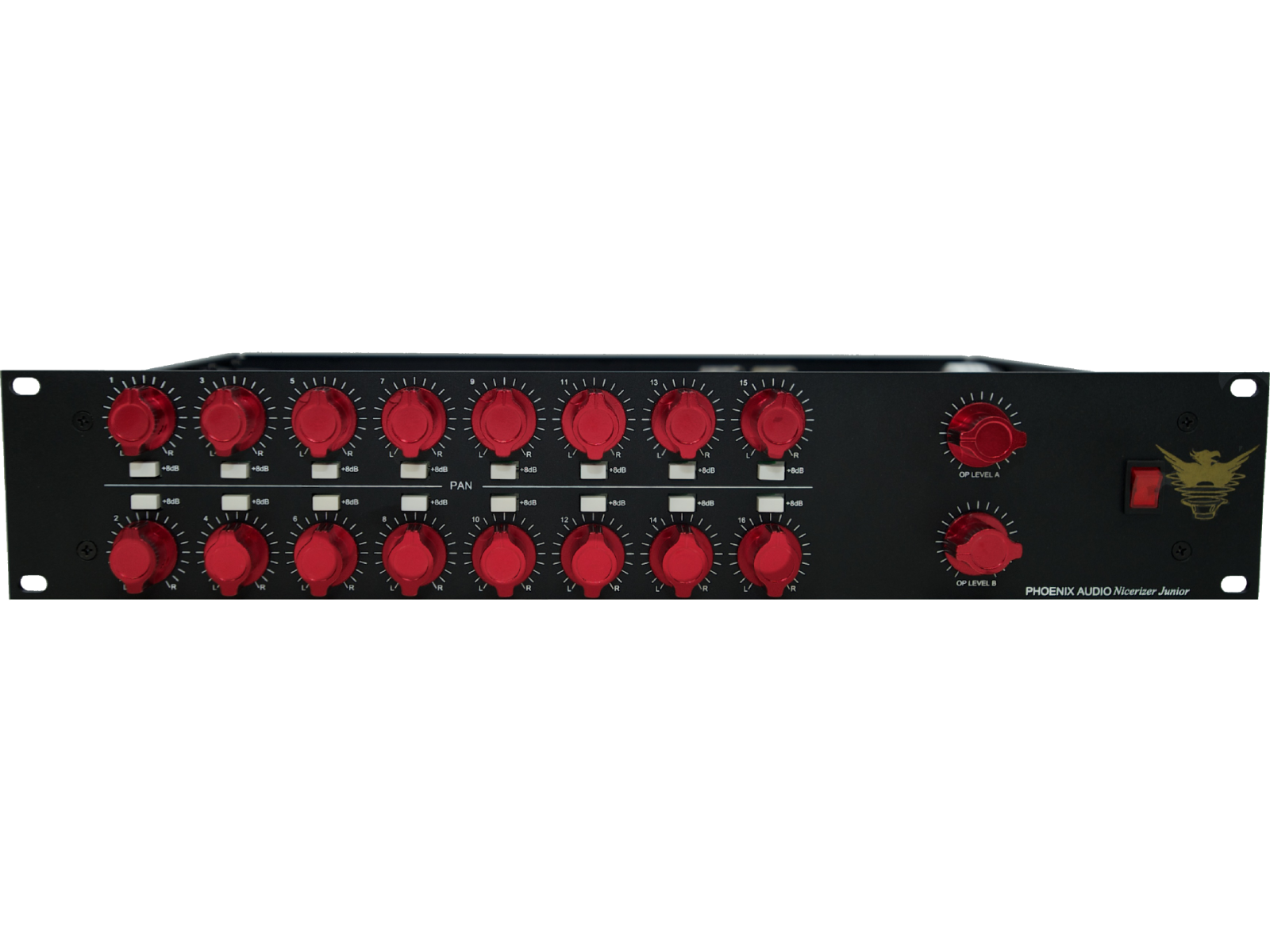
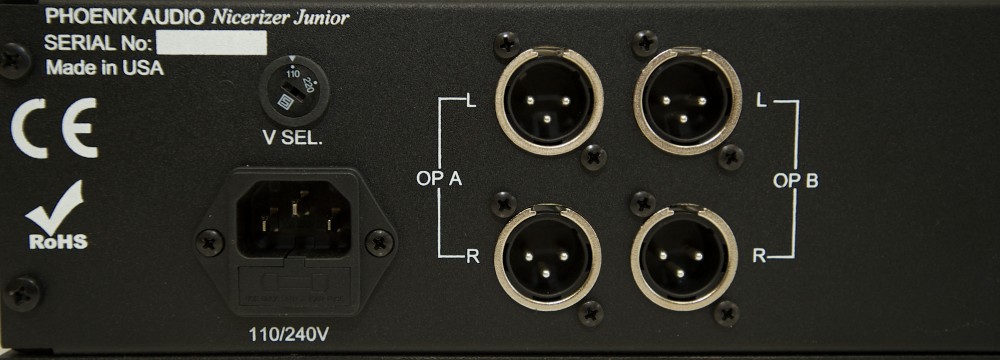
At a Glance The Nicerizer Junior is based on the Nicerizer 16 Mk2 2U 19″ rack mountable Class A Discrete Line Input Technology 16 Channels Custom transformers on outputs 4 x Balanced XLR’s outputs Class A characteristics 16 x Detented Pan pots Description The Little Brother Our flagship summing mixer, the Nicerizer 16 MkII, is renown for its precision imaging and robust tone. With the Nicerizer Jr. you can get all of that essential sound in a more affordable package. Analog Summing In The Digital Age Recording software companies brag about their “mixer,” but discerning engineers won’t settle for in-the-box mixing when the dimension, punch, and articulation of analog summing can vastly improve their productions. Phoenix’s Nicerizer series summing mixers incorporate features and circuitry that have made it a legendary tone machine. A Summing Mixer (not Amplifier) The Nicerizer is a true mixer, with precision, dented pan knobs on each of the 16 channels. Our dented pan-pots are unmatched for both precision stereo placement and ease of recall, and they are a key ingredient the huge, open sound of the Nicerizer. Driving a Versatile, Class-A Input CircuitTransformers slow things down, which can be great in some cases, but if you’re stuck with transformers, then you’re stuck with slower transients (slew-rates). The Nicerizer Jr.’s electronically balanced input stage can be driven modestly for ultra-clear hi-fi sound, or you can engage a +8db switch on any channel individually to drive the circuit for a fatter, more saturated sound that only Discrete Class-A buffer amps can deliver.Legendary Transformer-Balanced Output StageOnce mixed, the stereo signal hits a pair of our custom-wound DB694 output transformers, which we’ve coupled to Phoenix's proprietary, fully discrete DSOP-2 output amplifier. Even better, on the Nicerizer Jr. we’ve given you a pair of stereo main outputs, each with their own level control. The DSOP-2 represents the pinnacle of Class-A output circuits, offering a smooth transition from ultra-clean to beautifully saturated tones. Balanced, Unbalanced: No Problem—The Nicerizer’s 16 individual inputs can accept both balanced and unbalanced signals without any of the gain loss typical on most mixer inputs. This is an increasingly useful feature as looping through guitar pedals and even recording midi-driven analog synths in real time while mixing are fast becoming standard practices. Features 16 channels of our Class A, discrete, truly balanced transformerless input stage. Our proven and loved Class A, discrete, custom transformer balanced output stage (DSOP-2). Individual pan control for each channel with detented/stepped pots for extra control (16 x Pan pots) 16 x Balanced Input via D-sub inputs, wired as Tascam DA88 standard. Can accept balanced or unbalanced input with no -6dB loss. 4 x XLR balanced outputs with custom transformers on every output. +8dB Boost button on each channel. Two Master mix bus output level controls. Main Outputs on Balanced XLR’s Maximum Output Level of +26dB. Huge headroom available on all channels. All units are wired with PTFE silver plated military grade cable.


Pueblo Audio is always looking to provide solutions for its client's constantly changing needs. In an era of instant recalls and homogenous ITB production, busy mixers seek to bring higher caliber summing to their hybrid analog work flow. For this we present our newest product - HJ482 "SideWinder", a truly high-performance summing amp with routings and sonics not found in other products. HJ482 • Block Diagram "SideWinder" consists of four transformer-less, unity gain 8x2 summing banks. Each 8x2 bank may be operated independently and/or internally routed to the last bank (using front panel Bussing Switches) to form 16x2, 24x2, or 32x2 matrixes. In this case, Bank-D acts as a Main Buss for all banks assigned to it. Each individual bank's output remains active to serve as a Sub Group for stems, FX send, parallel processing or whatever you might dream up. The first two channels of each Bank may be assigned as a stereo or mono pair using internal jumpers. This flexibility allows the user to scale SideWinder to a specific project's needs while controlling noise build-up (see diagrams below). Other features include a Mono Switch for Bank-A which "pans" its mix elements to the center of the stereo field. This follows a -3dB pan law and only affects the bussing to Bank-D. Bank-D is fitted with a -6dB Gain Switch which (when engaged) helps control signal level build-up common with larger mixes. And if you need floating outputs (or enjoy the taste of iron in your mix), Bank-D is outfitted with bypass-able Output Transformers. Preliminary Specifications CMRR: -108dB [60 Hz, transformer in]Crosstalk: <-103dB [1kHz]THD: 0.00094% [1kHz, +22dBu, 20-20kHz]THD+N: 0.0011% [1kHz, +22dBu, 20-20kHz]SMPTE IMD: 0.0026% [250Hz+8kHz, 4:1] Dynamic Range: 127dBNoise: -98dBu [8x2, Rs=0Ω, 20-20kHz, A-weighted]Max. Input: +29dBu [12kΩ input impedance]Max. Output: +29dBu [10kΩ load, ≤ 0.004% thd]Max. Output: +27.5dBu [600Ω load, ≤ 0.004% thd] Bandwidth: DC to 1MHz [+0/-3dB]Spectral Accuracy: ±0.04dB [20Hz-40kHz]Slew Rate: 600V/µSLinear Phase Deviation: 0.0˚ [20Hz, transfomerless]Linear Phase Deviation: 0.3˚ [20Hz, transfomer In] As these specs reveal, SideWinder's attributes are phenomenal. Of note, SideWinder has 2 times lower distortion, 5 times wider bandwidth and 45 times better hum rejection than the next-best product. And, on a per-channel basis, Pueblo Audio delivers this level of performance at the lowest price on the market.

Those that already have a mixer in their studio may find the Workhorse mixer redundant. But there is no denying the convenience of being able to mix and match modules and the added excitement of producing new sounds by combining modules in series and in parallel. The MX8 makes it easy! And best of all, you can add the mixer after the fact... should your production needs change.


Tired of the flat, narrow sound of your Digital Audio Workstation? Do individual tracks sound full and deep while whole mixes sound lifeless and thin? Can you go analog without sacrificing the recall ability of the DAW or parting with the space and money required for a large automated console? Break out of the box and let your mixes breathe again. The RMS216 FOLCROM is a high quality passive mixer intended for analog summing of multichannel digital mixes. The sound is up to you and your preamps. Each of the Folcrom's sixteen input channels features a balanced analog connection on standard 8-channel DB25 connectors and a pair of pushbutton switches to assign that channel to the Left or Right output, neither, or both. It uses no active circuitry and provides no gain or level controls. By controlling all aspects of the mix from within the DAW, automation and recallability are perfectly preserved. Up to 16 different tracks or submixes can then be routed to the Folcrom for summing in the analog domain. The absence of faders, EQ, aux sends, pan knobs, or any other superfluous features not only preserves your software automation, it also allows for an elegant passive circuit using no amplifiers, ICs, transistors, capacitors, or transformers whatsoever. The simplicity of the fully balanced, symmetrical signal path allows the use of no-compromise passive components for an absolutely transparent signal path. The unit passes signals "from DC to daylight" without coloration. The output of the Folcrom is a stereo pair of balanced, 150-ohm signals on XLR connectors and requires approximately 30-40dB of make-up gain (program dependent). This signal is ideally suited for feeding into an outboard microphone preamplifier of your choosing. The mixbus is therefore able to assume the tonal character of the amplifier, providing a wide range of sonic flavors. Chances are your mike preamps just sit there unused at mixdown time anyway. Plug into your Great River MP-2 when you need pristine clarity; or put those old Telefunken or RCA tube preamps to work when you want super thick warmth. By excluding the make-up gain amplifier from the Folcrom, we are able to provide a unique opportunity for wide tonal control by allowing you to choose your flavor of make-up gain. At the same time, it enables us to produce an ultimate quality summing buss without compromise for well under a thousand dollars. What other analog console can give you so many options, in a single rack space, and at such a reasonable price?


Firmly rooted in six decades of console design experience, the 5057 Orbit gives your mixes the legendary tonality, power, and wide-open soundstage that only Rupert Neve’s class-A analog summing can provide. Coupled with Rupert’s famous custom audio transformers and Silk Red & Blue circuitry for variable harmonic saturation, the Orbit launches sterile in-the-box mixes to new heights of tone, depth and clarity – without compromising the recallable convenience and repeatability of your DAW-based workflow.
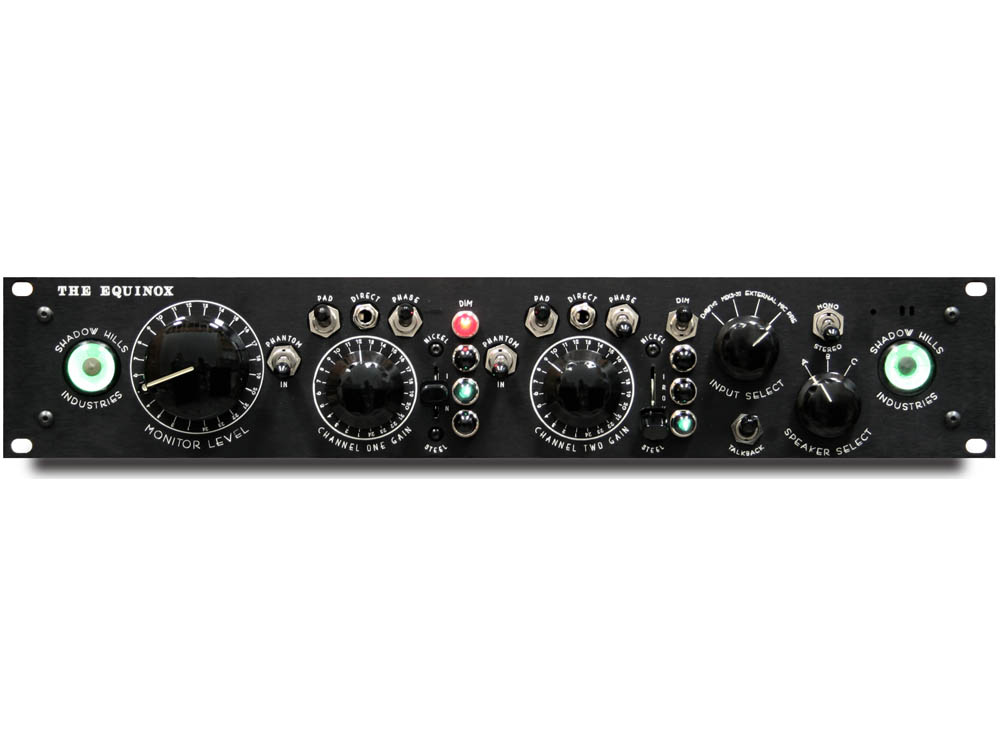
The Shadow Hills Equinox is a complete recording console. First, the control room section features a twenty-four-position discrete monitor volume control and a three-position speaker selector. The four position input selector chooses from: DAW 1+2, Channels 3 - 32 summed, 2-track or external input, and Mic Pre. The summing buss is a 30-channel mixer utilizing copper buss bars and esoteric resistors, for simply the finest sounding passive monitor section ever made. Combined through our switchable custom output transformers, Nickel, Iron, and Steel. Effectively giving you the sound of three different consoles. The Mic Pres are the same as our stellar Gama. There is a built in talkback microphone, a dim and a mono stereo switch, and VU-meters. The Equinox may just be the most solid two rack spaces ever built. With it you can record, mix, and monitor to the tolerance of a bygone era. The front panel is engraved. The knobs are bake-lite, and the two-rack space external power supply will work in any country on any voltage. A dual channel version of the Golden Age Microphone Amp, and Thirty-two channel summing mixer in a 2u package. The microphone preamp features three selectable output transformers, to create a broad pallet of sonic characteristics. 24 position Stepped input switches included. 60DB gain, phase, 48v, 1/4' DI. The mode switch selects between microphone preamp and sixteen or thirty-two channel summing mixer. The summing mixer uses hand matched esoteric holco resistors, The same type used in our mastering consoles and attenuators. The mixer output also uses the selectable output transformers, thus allowing three different sounding mix buss options. The control volume section includes: Control room volume, 3 speaker selector, 2x two track inputs. You toggle between your DAW stereo mix, the summing mixer's stereo output, or just the 2x mic pre outputs. Dim, mute and talk back. Rear panel connections: sum buss inputs via DB25, in stereo pairs. Odd/left, even/right. All other connections via XLR. Without PSU

Speck Electronics X.Sum + Breakout Box BB03 Speck Electronics X.Sum The X.Sum is a 32 x 4 line mixer that can be used for external DAW summing or as a line mixer for synths, samplers, and effect returns. Any of the 16 stereo channels can be assigned to either the main stereo Mix output or the stereo Mix-B output.Features:16 Stereo Line Inputs-Stereo level control.Pan/balance control.Mix assign switch that routes inputchannel to the main stereo mix orMix-B stereo mix.Mono Switch.Left and right balanced TRS inputs.Master Section-Master level control.Stereo/mono switchMonitor/Phone level provides adjustment to headphone jack and Mix-B output.·Balanced TRS stereo mix output.Expandable to 128 inputs.Technical Specifications:Frequency Response (12 dB gain):3Hz-54kHz (+0/-.5dB)THD+n (Gain 12, Output +24dBu):.0024%Noise (22Hz-22kHz):-102dBu (Residual output noise), -87dBu (16 channels routed, faders off)Maximum Input Level:+28dBuMaximum Output Level:+28dBuInput Impedance:30K Ohms (Balanced), 15K Ohms (UnbalancedOutput Impedance:60 OhmsDimensions (Mixer):WxHxD=1.75" x 19" x 10.75":(44mm x 483mm x 273mm)Dimensions (Power Supply):WxHxD=4.6" x 2.75" x 7.3": (117mm x 70mm x 185mm)Shipping Weight (Mixer & PS):15 Lbs (6.8kg) Breakout Box BB03The X.Sum is a 32 x 4 line mixer that can be used for external DAW summing or as a line mixer for synths, samplers, and effect returns. Any of the 16 stereo channels can be assigned to either the main stereo Mix output or the stereo Mix-B output. The BB-03 Breakout Box features a set of 1/4" TRS jacks to use the additional Mix-B outputs and a set of 1/4" TRS jacks for a second set of Mix-A outputs. Features:16 Stereo Line InputsStereo level controlPan/balance controlMix assign switch that routes input channel to the main stereo mix or Mix-B stereo mixMono SwitchLeft and right balanced TRS inputsMaster level controlStereo/mono switchMonitor/Phone level provides adjustment to headphone jack and Mix-B outputBalanced TRS stereo mix outputRJ-45 expander connectorDimensions: HxWxD=1.75"x19"x10.75" (44mm x 483mm x 273mm)


The MixDream is a cascadable, 16-in-2 analog mixer in a 19“/1U format. Any DAW or digital console can be expanded with high-grade analog stereo summing functionality. MixDream Advantages—An Overview Active analog summing on just 1U rack space—no analog mixing console necessary Sophisticated, active Class A/6oV stages for analog summing in the quality of the best consoles All analog tracks can be summed before A/D conversion. Channel adjustments and automation (level, panorama etc.) remain controlled from the DAW—no digital efficiency is lost Lower DAW processor utilization rates Latency free monitoring Surround capable (from up to 3 MixDreamXP units) Channel capacity expandable through linked units Proprietary differential amplifiers for each input The MixDreamXP design plan provides for stereo mixdown at the analog level. This concept offers high-grade analog summing without panorama and fader controls, in turn allowing an engineer to retain the entire scope of his computer automation. In use, the MixDreamXP requires almost no departures from an engineer‘s usual working mode, so that all his trusted DAW features and familiar working routines remain available while the MixDreamXP seamlessly expands his aural mixing palette. One MixDreamXP can sum up to 16 audio tracks to a stereo signal, and should the need arise for more than 16 tracks, several MixDreamXP may be linked together. Owners of a MixDream, model 2384, can expand this unit with the cost effective MixDreamXP at an identical quality level and by the way, that‘s where the suffix „XP“ comes from (=Expansion). The MixDreamXP discrete class A technology is based on the same 60-volt rails (+/- 30V) of the MixDream model 2384. Newly developed circuitry, based on the most modern analog components, guarantees an extremely high slew rate, a very low noise level of -97dBu and a dynamic range of 125dB. Thus the MixDreamXP easily reaches the technical level of the best analog consoles.
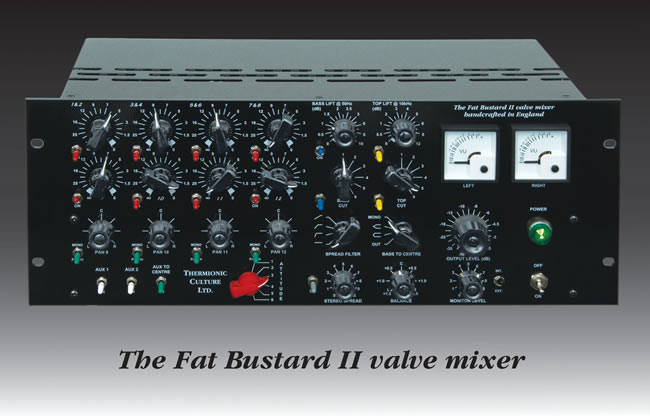
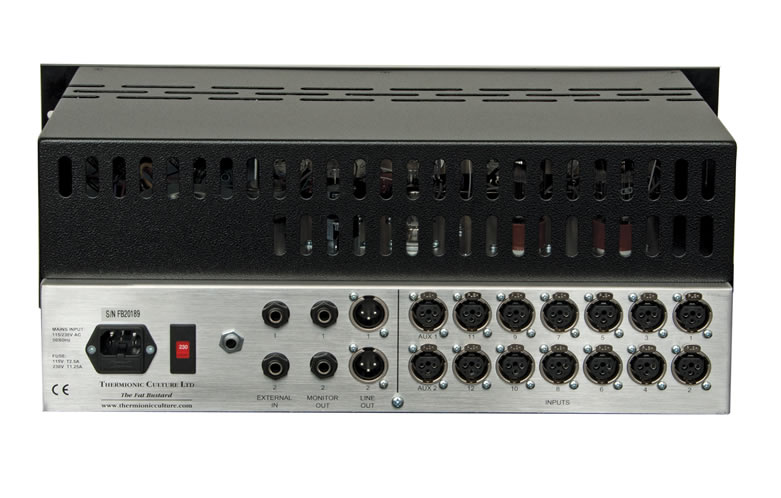
The Fat Bustard mk II is an all valve passive input summing mixer. It has 14 inputs with 4 stereo inputs, 4 mono pan-able inputs and 2 'Aux' inputs with a pan switch. The Fat Bustard is unique in it's exceptional sound quality and also the extra degree of control and processing it offers over the stereo mix output. The mk II version is now the standard production model and it has been upgraded to include a monitor output with level control. Much of the attractive sound provided by the Fat Bustard is down to the choice of valves used. The summing is done by a pair of 5965 valves and the output stage uses a pair of 6SN7 valves. This combination provides a very large amount of headroom and a unique smooth sounding response. It's also worth noting that the unit has "semi-floating" inputs and unbalanced outputs. This was a decision made at the design stage purely because the unit sounded better this way and performed excellently when connected for use in all situations. The Fat Bustard employs our unique "varislope" curves for top and bass lift. As the control is turned up, the peak frequency of the curve becomes more extreme so as to add heavier bass/brilliant top – without the hardness found in solid state eqs. The bass and top cuts provide a variety of options to tailor the sound – too many to list here. They are of course independent of the lifts. All controls affect both stereo channels equally. The 'Attitude' control is the next to control the sound of the mix.This switched control gradually increases the amount of harmonic distortion in the stereo summing stage. It is relatively subtle (at least in the lower positions) to provide just the right amount of 2nd harmonic content for a stereo mix. At high positions the mix can be quite aggressive. The stereo spread control allows the stereo to be widened by a continuous amount over a selectable frequency range. All valve 14 channel passive summing mixer with many extras ! Pan controls on 4 channels. Unique Varislope Top and Bass lifts plus filters. 'Attitude' control to add harmonics. Stereo width controls / Bass to centre and mono. Precision ELMA switch to control main level (fadeable). Monitor outputs with level control and switching. Hand wired with point to point wiring throughout. Exceptional sound quality- very low distortion except when required and massive 'headroom'. Frequency response extends from below audio range to well above.
The Fat Bustard mk II is an all valve passive input summing mixer. It has 14 inputs with 4 stereo inputs, 4 mono pan-able inputs and 2 'Aux' inputs with a pan switch. The Fat Bustard is unique in it's exceptional sound quality and also the extra degree of control and processing it offers over the stereo mix output. The mk II version is now the standard production model and it has been upgraded to include a monitor output with level control. Much of the attractive sound provided by the Fat Bustard is down to the choice of valves used. The summing is done by a pair of 5965 valves and the output stage uses a pair of 6SN7 valves. This combination provides a very large amount of headroom and a unique smooth sounding response. It's also worth noting that the unit has "semi-floating" inputs and unbalanced outputs. This was a decision made at the design stage purely because the unit sounded better this way and performed excellently when connected for use in all situations. The Fat Bustard employs our unique "varislope" curves for top and bass lift. As the control is turned up, the peak frequency of the curve becomes more extreme so as to add heavier bass/brilliant top – without the hardness found in solid state eqs. The bass and top cuts provide a variety of options to tailor the sound – too many to list here. They are of course independent of the lifts. All controls affect both stereo channels equally. The 'Attitude' control is the next to control the sound of the mix.This switched control gradually increases the amount of harmonic distortion in the stereo summing stage. It is relatively subtle (at least in the lower positions) to provide just the right amount of 2nd harmonic content for a stereo mix. At high positions the mix can be quite aggressive. The stereo spread control allows the stereo to be widened by a continuous amount over a selectable frequency range. All valve 14 channel passive summing mixer with many extras ! Pan controls on 4 channels. Unique Varislope Top and Bass lifts plus filters. 'Attitude' control to add harmonics. Stereo width controls / Bass to centre and mono. Precision ELMA switch to control main level (fadeable). Monitor outputs with level control and switching. Hand wired with point to point wiring throughout. Exceptional sound quality- very low distortion except when required and massive 'headroom'. Frequency response extends from below audio range to well above.
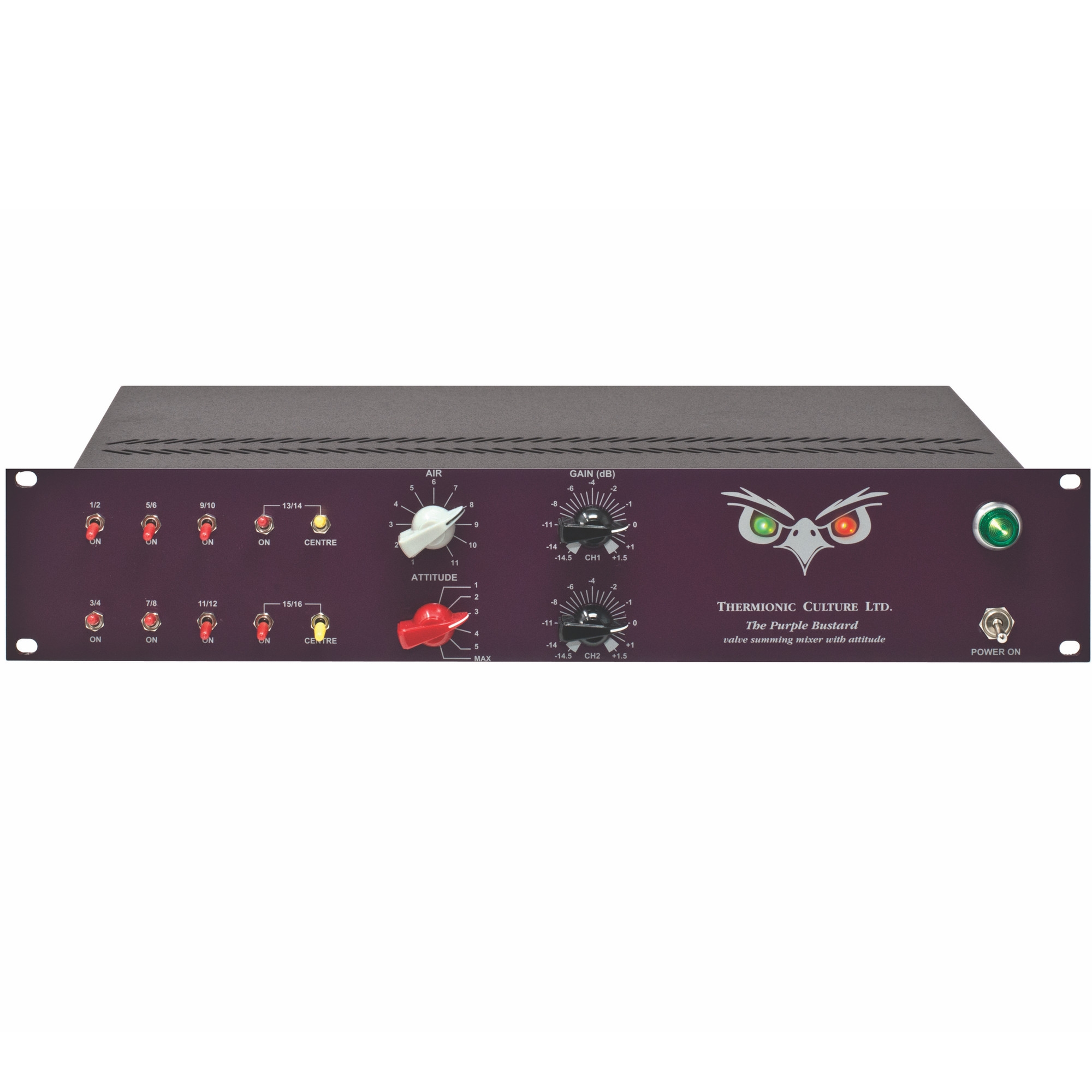
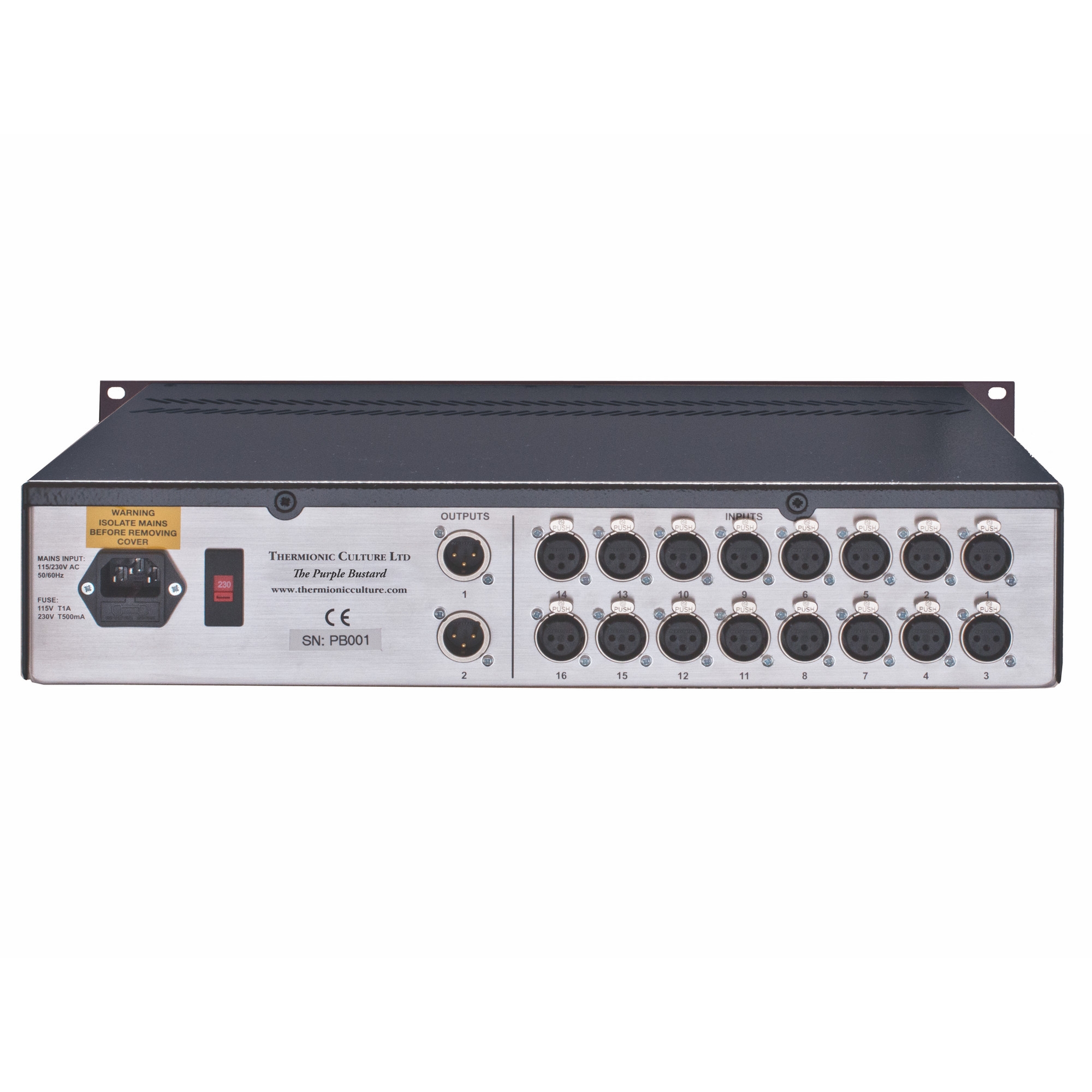
Features: All valve 16 input summing mixer; Each pair of inputs has its own on/off switch; Inputs 13 to 16 can be switched to centre; Attitude control adds musical 2nd harmonics; Air control increases high top end without solid state harshness; Frequency response extends well above and below audio range; Easily enough output to drive your DAW and very low noise; All inputs are “semi-floating” on XLRs; Outputs are unbalanced. A separate Balancing Box is an optional extra; Shares the same natural warmth as the Fat Bustard; Extremely low distortion (< 0.1%) before Attitude is added.


The Pyra-Sum is a passive summing mixer that has what other summing mixers don't: multiple cascading busses. This bussing architecture allows you to truly have the sound and workflow of a large format console but with even more sonic flexibility and in a much smaller format. We've left out any active circuitry, which means that you have total control of the coloration that's added in the makeup gain stages—it also means you'll need to use this with eight of your own preamps. Want a different sound? Swap the preamps. You could use Neve's or API's for that 70s sound. Tube RCA preamps for that 50s sound. UTA preamps for a size and musicality that has never existed before. Or, since the preamps are inserted after each stage of summing, you can mix and match— API's on the drums, UTA preamps on the music, Neve's on the vocals, etc. The sonic possibilities are endless. Features: Four discrete stereo summing busses Recreate the bussing architecture of a large format console Incorporate the sound and color of any mic preamps you choose All passive circuitry Make better use of all your favorite outboard gear Make Pyra-Sum the heart of your ultimate hybrid mixing setup